Schuch
Searching
Already as a young man in Vienna, Carl Schuch decided to pursue an artistic career. In his quest for a unique language of colour and form, he became deeply inspired by the modern art and culture of France.
„France had gone ahead and produced masterpieces in literature and painting that have since been widely imitated but are still unmatched in any other country.“
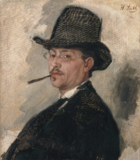
A keen gaze upon the world, dressed in gallant black and wearing a top hat, a cigarette casually resting in the corner of his mouth: the portrait shows Carl Schuch at the age of 29. Yet the painting by Wilhelm Leibl, a companion of Schuch’s, also hints at a deep melancholy.


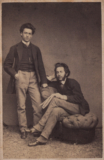
An inheritance from his parents made it possible: Schuch was able to afford an artistic education in Vienna. After abandoning his studies at the State Academy of Fine Arts, he took private lessons with the landscape painter Ludwig Halauska (1827–1882).
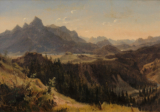
The death of his sister Pauline in 1869 prompted Carl Schuch to leave his hometown. The highly educated and polyglot young man went on a journey—through Italy, via Rome and Naples, and later also to Paris and Brussels, Amsterdam, Dresden, and Munich.
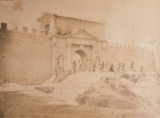
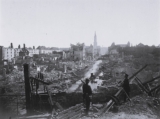
Around 1870, Europe was deeply divided politically. During a stay in Italy, Schuch witnessed the capture of Rome, which marked the end of the Italian Wars of Independence and led to the separation from the Austrian imperial crown and to national unification. At the same time, the Franco-Prussian War of 1870/71 was raging: This conflict brought about hundreds of thousands of deaths and severe destruction. It resulted in the founding of the German Empire and the end of the Second Empire, the Second French Empire. Schuch lived in times of upheaval – In his notebooks and letters, there are frequent references to the rapid political developments of his era, yet his paintings remain untouched by these events.
While journeying across Europe, Schuch’s gaze was ever drawn toward France. In museums and galleries, his particular attention lingered on the works of contemporary French artists. He was captivated by the new wave of painting emerging from France—where, from the mid-19th century onward, artists had broken with long-established conventions. In an era of profound transformation, they championed an art that was unprejudiced and sincere.
“The French succeeded in breaking away from the traditional way of seeing and in discovering a more natural and profound relationship with nature.“
Schuch’s enthusiasm for French art had good reasons: in Paris, artists, art critics, and intellectuals had already been debating, since the mid-19th century, a new meaning and social role for painting. Under the catchwords “Naturalism” and “Realism,” the relationship between art and reality was being redefined. Paintings were no longer to be created according to the rigid rules of the state art academies. Instead, what was demanded was the individual and impartial rendering of what was seen and experienced, with the aim of an art vivant—a “living art.” Free from unnecessary embellishment and indulgent idealization, these new forms of expression were meant to do justice to the modern world.


Authentic images of nature – impactfull, yet unembellished: the new landscape art emerged at a time of widespread industrialization and urbanization in Europe.


“We paint nature today as it appears to the unbiased, unprejudiced eye. Not as we ‘know it to be.’ Naïve!”
Truthful and
Unconventional
Creating art free of preconceptions – Carl Schuch shared this vision with his contemporaries. In Munich, he became part of the artistic circle surrounding the painter Wilhelm Leibl (1844–1900). What united them was a deep admiration for French art, especially for the great Gustave Courbet (1819–1877).
Shared working hours, common pictorial motifs, and similar painting techniques: in the 1870s Carl Schuch worked in close collaboration with the artists of the Leibl-Circle. Especially with Wilhelm Trübner (1851–1917) he developed a lively and creative exchange. In so-called still lifes – depictions of arranged objects – the artists tested their painterly skills.


“[Courbet] had an incomparable advantage – he was himself, stood on his own feet, saw with his own eyes, broke all conventions (…).”
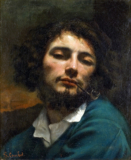
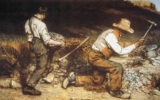
“The young people here paint entirely in my style,” wrote Gustave Courbet from Munich to his parents in 1869. Indeed, his realism and dazzling fame captivated an entire generation of artists. During his stay in Munich, Courbet was surrounded by admirers—including the circle around Wilhelm Leibl. Courbet sought an unembellished art: instead of heroes and saints, he painted farmworkers and maids; instead of conventional compositions, he pursued creative forms of representation and the artist’s individual perspective. His artistic demands went hand in hand with his political stance. When the Paris Commune rose up in 1870 during the Franco-Prussian War—against both the German occupiers and Napoleon III’s government—Courbet took part. He was among the instigators of the destruction of the Vendôme Column, a symbol of the monarchy. Schuch, however, felt no affinity with the Frenchman’s political side. He once wrote that Courbet’s great talent had greatly suffered from his “combative attitude.”
“Seeing and exploring for oneself” – that was Carl Schuch’s lofty ideal. He left the established norms and genres of art – painting by rules and recipes, as taught at the state art academies – to the “careerists.”
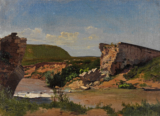
The bank of a pond in the Upper Bavarian surroundings of Munich – with this painting Schuch contradicted the viewing habits of his time: Schuch consciously turned away from the sweeping romanticism of more traditional landscape imagery.
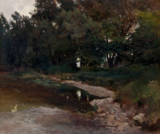
Inspired by Courbet’s innovations, Schuch modeled his compositions on the Frenchman’s example. In works such as this atmospheric stream landscape, the unconventional perspective and the narrow sliver of sky in the upper left corner were already foreshadowed.

Not only in France did artists in the second half of the 19th century pursue defined theoretical goals: Wilhelm Leibl, with whose circle Carl Schuch moved in Munich, declared “Reine Malerei” (“pure painting”) to be his maxim. Under the influence of Gustave Courbet, he developed the idea of an unadulterated, almost objective art that should reproduce nothing but what is seen. The focus was on form, colour, light, and materiality – in other words, on what is purely painterly. What a painting shows was less important for Leibl and his companions. They dedicated their art to the how – to colour design, brushwork, and the inner attitude of the painter.
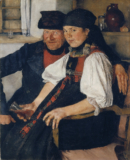
On his journeys through Europe, Schuch surrounded himself with art and artists who enriched and inspired him. But he refused to commit to any fixed school—let alone follow trends or the demands of the art market. When the painting methods of the Leibl circle began to feel too routine, he left Bavaria and moved to Venice.
“No matter how much you may have learned (…) the virtuosity of the mind is the real talent.”