Schuch
in Venice
Venice – city of water! Carl Schuch spent the years between 1876 and 1882 in the lagoon – and encountered the place with mixed feelings.
“Venice is a swamp for me.”
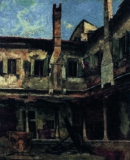
In Venice Schuch lived close to the Abbazia San Gregorio, the city’s oldest monastery. In his painting of 1878 he captured the façade of the inner courtyard. With refined brush technique, he conveyed the effect of the incoming sunlight in the picture.


Today Venice is a magnet for mass tourism. In Schuch’s time the lagoon was quieter, but already attracted wealthy people, artists, and intellectuals from Europe and the world. Countless painters had immortalized the houses, canals, and gondolas of the unique city for centuries.
“I see the time coming when Venice will offer me much. Once I advance thoroughly for a few more years, can properly paint landscape and air, and water, then I will subordinate architecture and paint only in light and colour, ships, water, etc.”
Carl Schuch shied away from bringing the unique beauty of Venice to the canvas. He led the life of a bachelor and devoted himself—with great perfectionism—to his notes and colour studies in his studio.
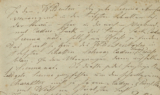
“I now have a piano, spend much time at home, frequent all the brothels, and on the whole feel more content.” With a striking frankness by today’s standards, Schuch candidly recounts his love affairs in his notebooks and letters. Angelina, Venturina, Elena, and Marie — some names of his lovers and prostitutes have been preserved, but their life stories remain unknown. He wrote from Venice to a friend that he had “not yet contracted syphilis,” yet he eventually did fall ill with a venereal disease that tormented him painfully until his death. Schuch’s lifestyle as a lifelong bachelor was shared by many European artists, composers, and writers of the 19th century. In an era when remaining unmarried was morally frowned upon, the role of the dandy or eternal bachelor was most readily tolerated among creative men. It was not until the age of 48, already seriously ill, that Schuch married in Vienna.

Winter in the Studio
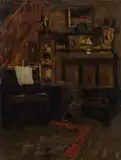
Schuch spent the winters in his Venetian studio. He read literature from France, studied works of fellow artists meticulously, and painted his own pictures – especially still lifes.
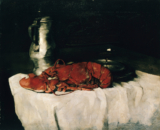
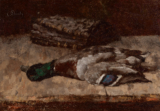
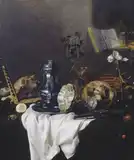
For a while, Schuch considered Lobster with Pewter Jug and Wine Glass one of his finest works, even thinking of exhibiting it. Yet nothing came of it. Public acclaim and the art market meant little to him. In fact, he is said to have sold only a single painting during his lifetime. It was only in 1904, thanks to the initiative of his friend Wilhelm Trübner, that the Lobster was shown at Eduard Schulte’s Berlin art salon—where Hugo von Tschudi, director of the Berlin Nationalgalerie, immediately purchased it for the museum.
Looking closely, exploring, and experimenting: Schuch used still life painting to examine the effect of colours under different qualities of light. How could the complex interplay of what is seen be conveyed in a painting? Schuch constantly subjected his painting strategies to new tests.


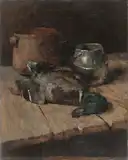


Still lifes come in all shapes and forms: During his winters in Venice, Schuch experimented with larger formats, which he later rejected. Too “large,” too “Prussian,” too little concerned with the “overall tone of the appearance”—this is how the painter described his elaborate compositions in hindsight.
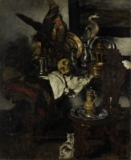
Composed in the manner of Flemish art of the 17th century: The Small Bric-a-Brac Shop of 1878 recalls the so-called vanitas still lifes of early modern Europe, which pointed to the transience of all worldly things. For the modern painter Schuch, however, the allegorical or trompe-l’œil function of the old art mattered less. In his painting he tested the logic of painting itself: How can brushstrokes be placed to reproduce different textures? What effects do subtle gradations of colour achieve?
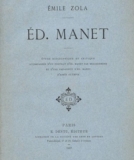
Schuch was a voracious reader—he read not only novels, but also the latest French debates on art and society. He devoured Jules Champfleury’s Le Réalisme and Émile Zola’s writings on naturalism. He wrestled with their central questions: What is the role of art in society? How does it relate to reality? In his notes, he tried to distill these theories into his own terms: “Naturalism embraces every subject in the sphere of natural imagination. Realism confines itself to what is personally experienced, directly seen.”

Summer in Nature
Summer meant landscapes! After the winters in Venice, Schuch headed out during the warm months—to the Puster Valley in Austria, across northern Italy, or into Brandenburg. All the painstaking studies he made indoors were, in the end, preparation for what he truly loved: painting natural surroundings.
“I must be in the midst of the nature I paint, so I can study it at every moment—walking, searching, looking, living in it, letting it sink into me until I become part of it. True landscape painting, especially as we understand it today, demands this intimacy.”
Sandy soils, mixed forests, and lakeside villages: Between 1879 and 1881, Schuch spent his summers in Brandenburg, in villages like Ferch on Lake Schwielowsee and Kähnsdorf on Lake Seddin, not far from the growing metropolis of Berlin.
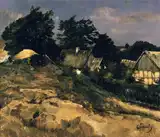
Observed with care, but never bogged down in detail: Schuch’s paintings capture the characteristic buildings, colours, and atmosphere of the Brandenburg landscape. Some of the paintings reveal an orientation towards French models.
Schuch’s Runoff Ditch at Kähnsdorf, for instance, shows his admiration for French painters like Charles-François Daubigny, whose lock and canal scenes Schuch had likely studied in Paris.
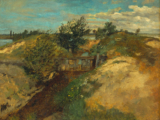

Sluices and locks bear witness to water techniques that are thousands of years old—and they, too, shape the character of a landscape. Schuch was intent on experiencing the natural environment he chose for his pictures in depth and often painted en plein air, in the midst of nature.


For Schuch’s landscapes the same holds true as for his still lifes: he did not simply copy what he saw but carefully rendered it with artistic means. Every dab of paint, every brushstroke was consciously placed, left visible, yet forms part of a harmonious and convincing whole.
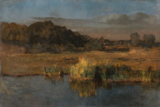
In his final months in Venice, Schuch studied extensively the changes of colours in sunlight and, in summer, painted the play of light and shadow outdoors.
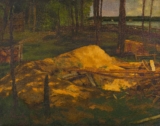
In his painting Saw Pit from the summer of 1880, Schuch translates the patches of light into radiant ochre and orange tones. He applies the colour generously onto the canvas without blending it with the brush. Schuch thus “materializes” the effect of sunlight.
“It was the French who first realized that the life of the landscape consists in light and air, in the atmospheric conditions which, when translated into art, give the prevailing tone, the mood of the picture.”
Recreating light effects, colour harmonies, and the mood of a landscape — French art remained Schuch’s enduring inspiration. Ultimately, it drew him away from Venice to Paris, the then epicenter of the art world.