Schuch
in Paris

The heart of cultural modernity! By 1882 Carl Schuch was no longer observing France from afar—he was living at its center. For more than a decade, until 1894, he immersed himself in the artistic life of Paris.
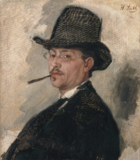
“Venice made me very ill: Paris is the climatic resort of the spirit.“

Carl Schuch in his notebook, 1882

Paris in the late 19th century was the hub of the world’s most innovative art movements. Impressionism, once ridiculed, had already broken through, and newer forms of modern art were emerging in a city undergoing rapid change.
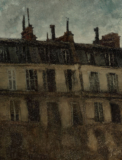
Carl Schuch, Parisian Buildings, c. 1871/1872
Oil on canvas, 63 × 50 cm, Belvedere, Vienna, inv. no. 3706, photo © Belvedere, Vienna / Johannes Stoll
City of Light
Charles Marville, Demolition work between Rue de l'Échelle and Rue Saint Augustin, 1877
J. Paul Getty Museum, Brown University Library
Charles Marville, Lamppost, Entrance to the École des Beaux-Arts, c. 1870
Albumen silver print from glass negative, 35.6 x 25.4 cm, Collection of W. Bruce and Delaney H. Lundberg
Notre-Dame de Paris, 19th century
Edgar Degas, At the Café-concert: The Dog's Song,1875–77
Gouache, pastel, and monotype, 57.5 x 45.5 cm, private collection
People beneath the Eiffel Tower in Paris during the World's Fair, 1889
Parisian Art Worlds

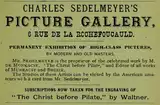
“An artist has no home in Europe except in Paris“ — so declared Friedrich Nietzsche (1844–1900) in 1888. At the time, the city’s art scene and art market were unmatched anywhere in the world. Carl Schuch took full advantage of this vibrant environment: he visited the Salon des artistes français, a major exhibition of contemporary art and the annual highlight of the Parisian art calendar. He also attended auctions at the Hôtel Drouot, the city’s central hub for the art trade. In the influential galleries of Charles Sedelmeyer, Paul Durand-Ruel, and Georges Petit, he saw exhibitions that included works by the Impressionists, among others.
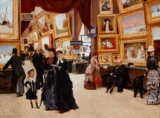
Edouard Dantan, A Corner of the Salon in 1880, 1880
Oil on canvas, 97.2 x 130.2 cm, private collection
Advertisement for Charles Sedelmeyer's gallery in Paris

Colour Play

Loose, visible brushstrokes, colours set boldly side by side—Schuch engaged deeply with Impressionist painting, especially admiring the works of Édouard Manet (1832–1883) and Claude Monet (1840–1926).

“In Impressionism there is an attempt to arrive at a stricter vision in colour and a truer effect of nature—that is the spark.”

Carl Schuch in his notebook, 1883/84
Édouard Manet, Flowers in a Crystal Vase, c. 1882
Oil on canvas, 32.7 × 24.5 cm, National Gallery of Art, Washington, D.C., Ailsa Mellon Bruce Collection, inv. no. 1970.17.37, photo © Courtesy National Gallery of Art, Washington, D.C.
Perhaps Schuch saw this small painting in January 1884—at a large special exhibition in honor of the recently deceased Édouard Manet at the École des Beaux-Arts in Paris. Schuch visited the show several times: he considered Manet one of the most innovative artists of his time.
Édouard Manet, Flowers in a Crystal Vase (detail), c. 1882
Oil on canvas, 32.7 × 24.5 cm, National Gallery of Art, Washington, D.C., Ailsa Mellon Bruce Collection, inv. no. 1970.17.37, photo © Courtesy National Gallery of Art, Washington, D.C.
This is not a classical still life painting: the depiction is sketch-like—in places the canvas is left unpainted—and yet it is a finished, signed work. With just a few lively brushstrokes, Manet put strong, unmixed colours side by side and into each other: a vivid appearance!
Claude Monet, Vase with Peonies, 1882
Oil on canvas, 100 x 81 cm, private collection
A bouquet of peonies by Claude Monet: the short, side-by-side brushstrokes and the contrasting colours are typical of Impressionist painting. For the human eye they create the impression of a shimmering liveliness that can resemble the natural play of light and colour.
Claude Monet, Vase with Peonies (detail), 1882
Oil on canvas, 100 x 81 cm, private collection
One blossom of the peony bouquet falls down—the painting conveys the impression of a single, unrepeatable moment. It was from such works that the Parisian critics coined the word impressionisme for the art of Monet and his companions—art as the rendering of an “impression,” a passing glimpse of reality.
Exploration of Colour

Red against green, or blue against orange — strong complementary contrasts filled the works of the Paris painters. Each of the three primary colours — red, yellow, and blue — has, as the mixture of the other two, a complementary counterpart, producing for the human eye a particularly powerful contrast. From the mid-19th century onward, theorists and scientists devoted themselves intensively to the laws of colour. The writings of the chemist Eugène Chevreul were especially influential in artistic circles. Chevreul also defined the principle of simultaneous contrast: when two colours are perceived directly side by side, they affect each other’s impact. Schuch and his contemporaries drew upon these insights from colour theory in shaping the palette of their works.
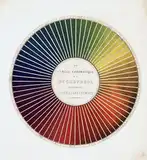
Illustration from Michel Eugène Chevreul's “Colours and Their Application in Industrial Art with the Aid of Colour Circles”
© Courtesy of Science History Institute

Flowers captured with loose, brisk brushstrokes — the painting Peonies, Beakers of Silver and Glass reveals Schuch’s engagement with Impressionist art. Yet while the painters of Impressionism translated natural light directly into unmixed, luminous colours, Schuch tempered many of his hues before applying them to the canvas.

Carl Schuch, Peonies, Beakers of Silver and Glass, c. 1886–1894
Oil on canvas, 63 × 78.2 cm, Staatsgalerie Stuttgart, on loan from Freunde der Staatsgalerie since 1906, inv. no. GVL 22, photo © bpk | Staatsgalerie Stuttgart

“However many colours one mixes together, the basic tone must always re-enter, restrain, harmonize, unify, and relate everything to itself.”

Carl Schuch in his notebook, 1881/82

Bold colour contrasts as the starting point of a painting! — yet unlike the Impressionists, Schuch wove these into a colour fabric of subtle gradations and interrelations. A “neutral ground” — in this work the white napkin and the pewter plate — serves to heighten the interplay of the many shades. From 1885 onward, Schuch referred to such carefully composed paintings as a “colouristic act.”
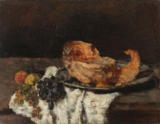
Carl Schuch, Pumpkin, Peaches, and Grapes, c. 1884–1897
Oil on canvas, 62 × 81 cm, Belvedere, Vienna, inv. no. 1358, photo © Belvedere, Vienna / Johannes Stoll
Colour Dots

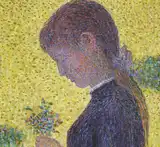
In 1886, Schuch witnessed the first exhibition of Georges Seurat’s (1859–1891) A Sunday Afternoon on the Island of La Grande Jatte in Paris. Today celebrated as a masterpiece, the painting quickly became the talk of the town: composed of densely placed, multicoloured dots and strokes, it astonished viewers. The human eye itself has to complete the image, blending the specks into forms and tones. With this sensational work, Neo-Impressionism was born. Its followers painted according to rigorous formal principles: they not only immersed themselves in the colour-theoretical literature of their time, but were also well acquainted with the latest studies in sensory physiology. Scientific insights into vision and human perception shaped the very foundations of their art.
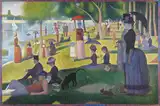
Georges Seurat, A Sunday on the Island of La Grande Jatte, 1884–86 (margins 1888–89)
Oil on canvas, 207.5 x 308.1 cm, Helen Birch Bartlett Memorial Collection, Art Institute Chicago, photo © Art Institute Chicago
Georges Seurat, A Sunday on the Island of La Grande Jatte (detail), 1884–86 (margins 1888–89)
Oil on canvas, 207.5 x 308.1 cm, Helen Birch Bartlett Memorial Collection, Art Institute Chicago, photo © Art Institute Chicago

Against discipleship! Schuch was intrigued by the artistic currents of 1880s Paris, with all their artistic and theoretical ambitions, yet he declined to follow them. From Impressionism he drew inspiration, but he forged his own path and his own solutions.

“(…) already Impressionism is trampling out the spark it once had—each one trying to outdo the other in manner instead of in spirit and self-searching.”

Carl Schuch in his notebook, 1883/84

A vision of his own

An artist must follow his own path — this principle guided Schuch throughout his life. Vision itself, he believed, was subjective—something his contemporaries in science were also beginning to affirm. Schuch shared with his Parisian contemporaries a deep interest in questions of optics and sensory physiology.

“Every human being is unique and exists only once.”

Carl Schuch in his notebook, 1881/82
Édouard Manet, Bunch of Asparagus, 1880
Oil on canvas, 46 × 55 cm, Wallraf-Richartz-Museum & Fondation Corboud, Cologne, inv. no. Dep. 318, photo © bpk | Rheinisches Bildarchiv, Cologne
A bundle of asparagus, seen through the eyes of a great artist! — Édouard Manet’s Asparagus Still Life left a deep impression on Schuch in Paris in 1884. To this day, the painting remains an icon of modern art: it testifies to the fleeting encounter between artist and object.
Carl Schuch, Serviette and Bunch of Asparagus, 1883 and later
Oil on canvas, 64 × 79 cm, Arp Museum Bahnhof Rolandseck/Sammlung Rau für UNICEF, inv. no. GR 1.513, photo © Arp Museum Bahnhof Rolandseck / Sammlung Rau für UNICEF / Mick Vincenz, Essen
Inspired by Manet’s asparagus still life, Schuch painted a whole series of his own. With each version he rearranged the objects— in this case a pewter plate, a basket and a napkin.
Carl Schuch, Bunch of Asparagus, Glass, and Clay Casserole, c. 1886–1894
Oil on canvas, 79 × 63 cm, Bayerische Staatsgemäldesammlungen, Munich – Neue Pinakothek, inv. no. 8907, photo © bpk | Bayerische Staatsgemäldesammlungen
Each asparagus still life captivates with its own mood and tone — at times cooler, at times warmer. Schuch translated what he saw into ever-new, sophisticated compositions of objects, light, and subtle gradations of colour.
Carl Schuch, Basket of Apples, Bunch of Asparagus, and Pewter Jug, c. 1886–1894
Oil on canvas, 62 × 77.5 cm, Kunstmuseen Krefeld, inv. no. GV 1916/200, photo © Kunstmuseen Krefeld / Volker Döhne – ARTOTHEK
Such work reflected the growing realization of the late 19th century: there is no single, objective way of seeing. What we perceive is shaped not only by light and color, but also by memory, emotion, the physiological and psychological state of the observer.
Carl Schuch, Studio in Paris, c. 1885
Oil on canvas, 65.5 × 82 cm, Städtische Museen Freiburg, Augustinermuseum, loan from Sammlung Morat, inv. no. 2022/293, photo © Städtische Museen Freiburg, Augustinermuseum, loan from Sammlung Morat / Bernhard Strauss
What does it mean to render reality in a painting? Schuch seems to reflect on this question in his sketch of his Paris studio. On the easel, one of his asparagus still lifes takes shape; on a table to the right, the objects to be painted are arranged upon rough wooden boards.

By the late 19th century, the idea of vision as something stable and objective was being dismantled. Physiologists and early neuroscientists showed that what we see is shaped as much by the body and mind as by the outside world. The eye does not simply record; it compares incoming stimuli with memory and prior experience. Schuch and his fellow artists in Paris followed these developments closely.

Not isolated paintings, but sequences of images — in Paris Schuch continually altered his artistic inventions. At times he changed the arrangement of objects and the play of colours only imperceptibly. From canvas to canvas, Schuch edged closer to a reality whose very appearance is ever in flux.

Carl Schuch, Apples on White, with Knife, c. 1886–1894
Oil on canvas, 61.5 × 78.5 cm, Niedersächsisches Landesmuseum Hannover, inv. no. PNM 940, photo © Niedersächsisches Landesmuseum Hannover – ARTOTHEK
A sequence of three still lifes: the red and yellow tones of the apples glow against the white tablecloth. Reflections shimmering on the glass carafe and the pewter vessel intensify the play of light and color.
Carl Schuch, Apples on White, with Peeled Apple, c. 1886–1894
Oil on canvas, 66.2 × 81.6 cm, Kunstpalast, Düsseldorf, inv. no. M 4527, photo © Kunstpalast, Düsseldorf
Almost the same scene, and yet an entirely new image. Schuch paints the tablecloth each time with different tones and strokes: the fabric does not appear as a fixed surface, but rather as a shifting mass or landscape — at times flowing, at times rugged.
Carl Schuch, Apples on White, with Half Apple, c. 1886–1894
Oil on canvas, 63 × 79.5 cm, Städel Museum, Frankfurt am Main, inv. no. SG 960, photo © Städel Museum, Frankfurt am Main
The apple in the foreground suggests a temporal sequence across the three paintings: from peeling to the eating of the fruit. Only a few moments separate this implied action, and yet the appearance of the world is transformed — each canvas possesses its own resonance.
Schuch and Cézanne

Not long after his death, critics began comparing Carl Schuch with Paul Cézanne, the “forefather of modern art.” Whether they ever met in Paris remains uncertain, but their approaches resonate. In contrast to the Impressionists, who sought to capture the fleeting impression of nature, both artists pursued a deeper pictorial inquiry: how can a painting be shaped so as to reflect both the laws of the world and the singularity of perception? What, amid all transience, is the inner coherence of the visible world? In seeking answers to these questions, Schuch and Cézanne each forged a pictorial language that was wholly their own.
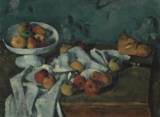
Paul Cézanne, Still Life with Fruit Dish, Apples and Bread, 1879/1880
Oil on canvas, 55.1 × 74.4 cm, Swiss Confederation, Federal Office of Culture, The Oskar Reinhart Collection ‘Am Römerholz’, Winterthur, inv. no. 1921.2, photo © The Oskar Reinhart Collection ‘Am Römerholz’, Winterthur

In Schuch’s work, the artist’s hand and mind is always visible: objects shifted, brushstrokes boldly declared. For him, what mattered was temperament—the unique sensitivity of the painter.

“What shapes artistic expression is not only the how (the individual manner), but also the intensity of feeling.”

Carl Schuch in his notebook, 1881/82

Delicate, melancholic, and somber — some of Schuch’s still lifes from his Paris years recall musical pieces in a minor key. These paintings, like those of his contemporary Antoine Vollon, share an undertone of sadness. They convey a profound pensiveness, standing in marked contrast to the fleeting brightness of Impressionist colour.
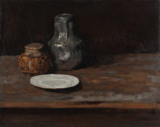
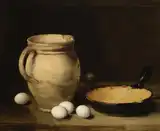
Antoine Vollon, Jug and Eggs, 1892
Oil on panel, 45.7 × 60.8 cm, Musée des Beaux-Arts, Lyon, inv. no. B 537, photo © Musée des Beaux-Arts, Lyon / Alain Basset
Carl Schuch, Ginger Jar with Pewter Jug and Plate, c. 1885–1888
Oil on canvas, 65 × 81 cm, Museum Wiesbaden, inv. no. M 597, photo © Museum Wiesbaden / Bernd Fickert
Beneath the surface

At times it is worth looking beneath the surface of a painting: X-ray analysis has revealed hidden layers within Schuch’s Ginger Jar with Pewter Jug and Plate. Beneath the visible composition lie earlier arrangements that the artist painted over and transformed. What first depicted a tin can, garlic, and fruit became a pewter jug, a plate, and a rectangular basket. Finally, Schuch shifted the jug to the right and introduced the ginger jar. Not only in his sequences of paintings, but even on a single canvas, Schuch worked tirelessly to explore ever-new pictorial constellations.
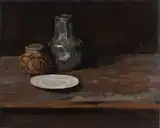
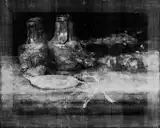
Carl Schuch, Ginger Jar with Pewter Jug and Plate, c. 1885–1888
Oil on canvas, 65 × 81 cm, Museum Wiesbaden, inv. no. M 597, photo © Museum Wiesbaden / Bernd Fickert / x-ray image of the painting, Foto © Städel Museum -Stephan Knobloch

„[An artwork] is a frgament of truth seen through a temperament.“

Carl Schuch in his notebook after Émile Zola, 1881/82