Schuch
in Essence
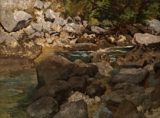
Exploring and bearing witness to the visible world—Carl Schuch’s true calling remained landscape painting. Even during his twelve years in Paris, he spent his summers out in nature. In the Franche-Comté, on the edge of the Jura Mountains, he created some of his most captivating landscapes.
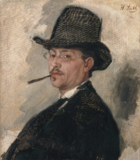
“For me, the only thing that truly matters in a landscape is colour.”
Stones in the riverbed of the Doubs — a simple scene commanded Schuch’s painterly devotion. What drew him to the Franche-Comté, the homeland of his exemplar Gustave Courbet, were not spectacular panoramas or dramatic natural formations. From 1886 onward, Schuch spent seven or eight summers in the Franche-Comté, along the French-Swiss border.



In his landscapes, Schuch applied what he had tested in his still lifes: he painted certain sections of scenery repeatedly, as sequences of images. How does the structure of a picture change under shifting conditions of light and weather? Which sensations are carried along with it? And what is — despite all transience — the underlying coherence of visible nature?


Secrets of nature
At first glance, Schuch’s landscapes may appear conventional—gentle tones, balanced compositions, atmospheric beauty. But the closer one looks, the more restless and dynamic they become. His brushwork reveals an intensity beneath the surface, suggesting that he aimed not just to represent nature but to probe its inner structure.
“We must paint our pictures deeper than nature itself (…).”

An old sawmill by the river, water rushing over ancient rocks: through light, colour, and form, Schuch created deeply moving, atmospheric images. His woven layers of brushstrokes seem at times to penetrate nature’s very fabric, as if painting could touch upon its hidden structures and invisible connections.
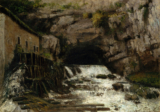
This painting was not created by Carl Schuch but by Gustave Courbet. It depicts the source of the River Loue near Courbet’s birthplace of Ornans. His landscapes of home oscillate between symbolism and natural description. As images of origin, they embody geological conceptions of deep time: strata of rock and coursing waters bear witness to the formation of the landscape over millions of years. At the edge of the Jura mountains, Schuch followed in Courbet’s footsteps.
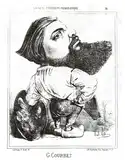
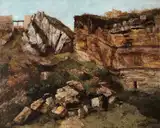
Layer upon layer of paint — with his palette knife, a kind of painter’s spatula, Gustave Courbet recreated on canvas the cliffs and rock strata of the Jura landscape. His unconventional technique provoked both ridicule and admiration: his depiction of the Roche Pourrie (“rotten rock”) was even commissioned by the geologist Jules Marcou (1824–1898), who marveled at Courbet’s precision in rendering geological formations. Courbet included his friend in the painting itself, as a tiny, barely discernible figure. In the 19th century, theories of rock formation and mountain building were being developed systematically for the first time. The realization that rock masses shift and change over millions of years, bearing within them the deep time of the Earth, inspired awe in many observers—not least in Courbet.
How can the structures of stone be captured in a painting? Schuch looked to Courbet’s palette-knife technique in order to render the rocks of the Jura. With the knife he built up and shaped the paint, layering it across the canvas.

Schuch’s depictions of the rapids of the River Doubs possess an almost intangible quality: the forms of nature dissolve into fascinating modulations of colour, while spatial order blurs. Schuch once wrote that through his art he sought to capture something essential in the harmony of colours — to convey, by means of painting, the “ethereal essence of appearance.”
To modern ears, Schuch’s phrase “ethereal essence” may sound esoteric. In the 1880s, however, the term belonged to the vocabulary of physics. The notion of an ether — an invisible, all-pervading medium — was part of the scientific worldview. Since the 17th century, the theory of ether, imagined as an elastic, malleable substance, had repeatedly been invoked to explain the propagation of waves. Schuch was likely familiar with the idea that ether — as a medium permeating all space — carried electromagnetic waves, above all light, and thus governed the appearance of the visible world. Only with Albert Einstein’s (1879–1955) theory of special relativity did the ether hypothesis lose its validity in the early 20th century.
“Tone has the task of stripping things of their material weight, holding onto only the ethereal essence of their appearance.”

Carl Schuch — a profound and fascinating artist, well worth rediscovering! To encounter his paintings in the original, and to linger before them, is to be carried away. Created in an era of sweeping change, his works reveal the deep beauty of our world. They invite us to savor, to reflect, and to marvel.